Why a Dental Implant May Be the Best Choice for Replacing a Missing Tooth

A missing tooth can feel like a small gap, until it starts affecting the way you chew, speak, smile, or even bite into your favourite foods. Many people learn to live around it. They chew on the other side. They hide their smile in photos. They tell themselves it is “just one tooth”.
But a missing tooth is not only a cosmetic issue. Teeth work as a team. When one is lost, the surrounding teeth, gums, jawbone, and bite all start adjusting to that empty space. Over time, those changes can create bigger dental problems.The Long-Term Benefits of Investing in Dental Implants for Missing Teeth
If a person is healthy enough and has the right bone and gum support, a dental implant can be one of the most reliable and natural-feeling ways to replace a missing tooth.
This article is for general information only. A dentist or implant specialist should assess your mouth, medical history, scans, and bite before recommending treatment.

What happens when a tooth is missingAppointments
A missing tooth leaves more than a visible gap. It changes the balance of the mouth.
Every tooth has a job. Some cut food, some tear it, and others grind it. Teeth also support each other. When one tooth is gone, nearby teeth may slowly tilt into the empty space. The opposite tooth may start moving down or up because it no longer meets a biting partner.
That can lead to:
Food getting trapped in awkward spaces
Difficulty chewing on one side
Uneven pressure on other teeth
Jaw discomfort or bite changes
Increased risk of tooth wear
Changes in speech, especially for front teeth
A dip in confidence while smiling or talking
The jawbone is affected too. Natural tooth roots stimulate the bone when you chew. Once a tooth is removed, that stimulation stops in that area. Over time, the bone may shrink. This is one reason dentists often suggest replacing a tooth sooner rather than later, especially if an implant is being considered.
A missing molar may not show when you smile, but it still matters. Back teeth take heavy chewing pressure. When one is missing, the rest of the mouth often compensates.
Why an implant feels different from other options
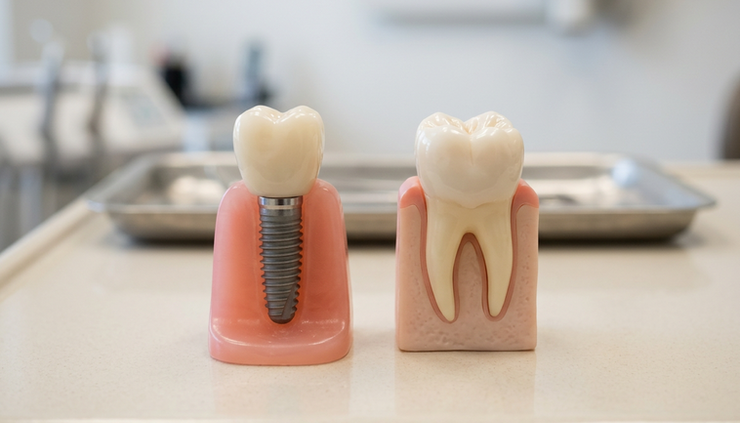
A dental implant is not just a visible replacement tooth. It replaces the root as well.
An implant usually has three parts:
The implant post
A small titanium or ceramic post placed in the jawbone.
The abutment
A connector that sits between the implant and the crown.
The crown
The visible tooth-shaped part made to match your bite and smile.
Once the implant integrates with the bone, it acts as a strong foundation for the crown. This is what makes implants feel different from removable dentures and different from bridges that depend on neighbouring teeth.
A well-planned implant does not simply fill the gap. It restores a chewing unit.
The biggest benefits of choosing an implant
When someone fits the criteria, an implant can offer several long-term advantages.
It protects the neighbouring teeth
A traditional dental bridge can be a good treatment in many cases, especially when adjacent teeth already need crowns. But if the teeth on either side of the gap are healthy, a bridge often requires shaping them down to support the replacement tooth.
An implant usually avoids that. It stands independently in the missing tooth space, without relying on nearby teeth for support.
That makes it a more conservative choice in many single-tooth cases.
It helps maintain jawbone support
Because an implant sits in the jawbone, it can provide stimulation in the area where the natural root used to be. This may help reduce bone loss around the missing tooth site.
This matters for both health and appearance. Bone shrinkage can change the shape of the gum and, in some areas, the facial profile. The front of the mouth is especially sensitive to these changes.
It feels stable while chewing
A removable denture can replace appearance and some function, but it may shift during eating or speaking. An implant-supported crown does not move in the same way because it is fixed.
People often describe an implant crown as feeling close to a natural tooth after healing. It lets them chew more comfortably and enjoy a wider range of foods, provided the implant is healthy and properly maintained.
It can look very natural
Modern implant crowns are carefully shaped and shaded to blend with nearby teeth. For front teeth, the dentist also considers gum shape, smile line, and how light reflects from the crown.
The goal is not to create a tooth that looks too perfect. The goal is to create one that belongs in the smile.
It is easy to live with day to day
An implant crown is not removed at night. It is cleaned with brushing, flossing, and sometimes special brushes or water flossers, depending on the position.
There are no clasps, no denture adhesives, and no need to remove it before eating. For many people, that simplicity is a major advantage.
When an implant may be the right fit
Not every person is an immediate candidate for an implant. A dentist will check several factors before saying yes.Appointments
Good candidates often have:
Healthy gums or gum disease that is under control
Enough jawbone to support the implant
Good general health for minor oral surgery
A bite that can be managed safely
A commitment to daily cleaning and regular dental visits
No uncontrolled medical condition that could affect healing
Some people need extra steps before implant placement. For example, if the bone is thin, a bone graft may be recommended. If the gums are inflamed, gum treatment may come first. If the tooth was removed due to infection, the area may need time to heal.
Certain habits and conditions can also affect success. Heavy smoking, uncontrolled diabetes, poor oral hygiene, teeth grinding, and untreated gum disease can increase the risk of implant problems. That does not always mean an implant is impossible, but it does mean the dentist must plan carefully.
The best implant treatment starts with a full assessment. This may include X-rays, 3D scans, bite evaluation, oral hygiene checks, and a discussion about medical history.
How implants compare with bridges and dentures
There is no single “best” tooth replacement for everyone. The right option depends on the mouth, budget, time, health, and personal preference.
Here is a simple comparison.
Option | How it works | Main advantage | Main limitation |
Dental implant | A fixed crown is supported by an implant in the jawbone | Feels stable and does not depend on nearby teeth | Needs enough bone, healing time, and surgery |
Dental bridge | A replacement tooth is attached to crowns on nearby teeth | Fixed solution that can be completed faster in some cases | May require shaping adjacent teeth |
Removable denture | A removable appliance fills the missing tooth space | Often less invasive and may suit multiple missing teeth | Can feel less stable and may need adjustments |
For a single missing tooth with healthy neighbouring teeth, an implant often has a strong advantage. It replaces the tooth without involving the teeth beside it. For multiple missing teeth, implants can also support bridges or dentures, depending on the case.
The key is personalised planning. A back molar, a front tooth, a long-standing gap, and a fresh extraction site all need different thinking.

What the implant journey usually looks like
The implant process takes time because the body needs to heal. While timelines vary, the journey often includes these stages.
Consultation and planning
The dentist checks the missing tooth area, gums, bone, bite, and medical history. Scans help show bone height, bone width, and nearby structures.
This stage is where good implant treatment begins. Placement angle, crown shape, gum health, and chewing forces all matter.
Tooth removal or site preparation
If the damaged tooth is still present, it may need extraction. In some cases, an implant can be placed soon after removal. In other cases, the dentist may wait for healing or perform bone grafting first.
The right timing depends on infection, bone condition, gum shape, and smile demands.
Implant placement
The implant is placed into the jawbone under local anaesthesia. Many patients are surprised that the procedure is more comfortable than they expected, though soreness and swelling can happen afterwards.
The dentist gives aftercare instructions, including what to eat, how to clean the area, and which activities to avoid during early healing.
Healing and integration
During healing, the bone grows around the implant surface. This process gives the implant its stability. It can take a few months, depending on the jaw, bone quality, and whether grafting was done.
A temporary tooth may be possible in some cases, especially for visible areas, but it must be designed carefully to avoid too much pressure on the healing implant.
Crown placement
Once the implant is ready, the dentist takes impressions or digital scans. A crown is made to match the shape, colour, and bite.
After fitting, the dentist checks how the teeth meet. This step is crucial. Even a small high spot can place extra force on the implant.
Why timing matters after losing a tooth
Waiting too long can make replacement more complex.Consequences of Not Replacing Missing Teeth
After tooth loss, the bone in that area may slowly reduce. Nearby teeth may move. The bite may shift. The gum shape may change. None of this happens overnight, but the changes can add up.
Replacing a missing tooth earlier may help:
Preserve space for the new tooth
Reduce shifting of nearby teeth
Make implant planning easier
Avoid more complex grafting in some cases
Restore chewing balance sooner
That said, people who lost a tooth years ago should not assume they have missed their chance. Many long-standing gaps can still be treated. The dentist may simply need more detailed planning, and sometimes additional procedures.
Caring for an implant is simple, but not optional
An implant cannot get decay like a natural tooth, but the gum and bone around it can still become infected. This condition is often linked to plaque buildup and inflammation.
Good care protects the investment.
Daily habits matter:
Brush twice a day with the right technique
Clean between teeth and around the implant
Use interdental brushes if advised
Avoid smoking or work towards quitting
Wear a night guard if you grind your teeth and the dentist recommends one
Visit the dentist for regular reviews and cleaning
Think of an implant like a natural tooth that needs a clean, healthy environment. It is strong, but it is not maintenance-free.
Common worries people have about implants
Many people like the idea of an implant but feel nervous about the process. That is normal.
Will it hurt?
Implant placement is usually done under local anaesthesia, so the area is numb during the procedure. Some discomfort, swelling, or tenderness can happen afterwards, especially in the first few days. Dentists usually explain pain control and aftercare before treatment.
Will it look fake?
A well-made implant crown should blend with the surrounding teeth. The final look depends on crown material, gum health, tooth position, and the skill of the dental team.
Front teeth need extra attention because the gum line and tooth shape are more visible.
Is it too expensive?
Implants can cost more upfront than some other options. The value comes from their function, independence from neighbouring teeth, and long-term comfort when properly maintained.
It helps to compare options not only by initial cost, but also by lifespan, maintenance, and future treatment needs.
What if the implant fails?
Implants have a strong track record when properly planned and cared for, but no medical or dental treatment has a 100 percent guarantee. Infection, poor healing, smoking, uncontrolled health conditions, overload from grinding, or inadequate cleaning can lead to problems.
Regular reviews help catch issues early.

The best choice is the one that fits your mouth
A missing tooth should not be ignored, even if it is not visible when you smile. The gap can affect chewing, tooth position, jawbone support, and confidence over time.
For the right candidate, an implant offers a rare mix of benefits. It looks natural, feels stable, protects neighbouring teeth, and helps restore chewing function in a way that closely resembles a natural tooth.
The smartest next step is a proper dental assessment. Appointments Ask what options suit your bone, gums, bite, health, and budget. If an implant fits the criteria, it may be one of the most worthwhile choices you make for your long-term oral health.


Comments